

Selecting the Right Tool for Your Routes, Materials, and Fleet
Choosing between box style and tub style roll-off containers is not a cosmetic decision. It directly affects payload efficiency, maintenance cycles, unloading time, and long-term asset performance.
Both designs are proven. Each serves a different role inside professional hauling, construction, and municipal fleets. The key is matching container geometry to material type, duty cycle, and truck configuration.
Roll-Off Containers in Professional Operations
Roll-off containers are engineered steel assets designed to be loaded, hauled, dumped, and redeployed repeatedly using cable hoist or hook lift systems.
They are used across:
- Construction and demolition (C&D)
- Scrap metal and recycling
- Municipal and commercial waste
- Roofing and renovation
- Route-based junk hauling
The two dominant designs—box style and tub style—solve different operational problems.
Box Style Roll-Off Containers

Design Overview
Box style containers use straight, vertical sidewalls with external reinforcement columns and a flat floor. This geometry prioritizes rigidity, impact resistance, and uniform load distribution.
Core Characteristics
- Rectangular, straight-sided profile
- Reinforced sidewalls with support columns
- Flat floor for even load distribution
- Rear swing doors for walk-in and machine-assisted loading
- Commonly produced from 10 to 40 cubic yards
Where Box Style Containers Excel
- Concrete and masonry
- Scrap metal
- Heavy C&D debris
- Industrial waste streams
- Municipal cleanups
Operational Advantages
- Structural strength: Handles repeated high-impact loading without sidewall deformation
- Load control: Flat floor supports dense, stacked, or palletized material
- Longevity: Reinforced construction extends service life under abuse
- Predictability: Performs consistently across demanding routes
Box style containers are typically the backbone of fleets handling dense or abrasive materials.
Tub Style Roll-Off Containers
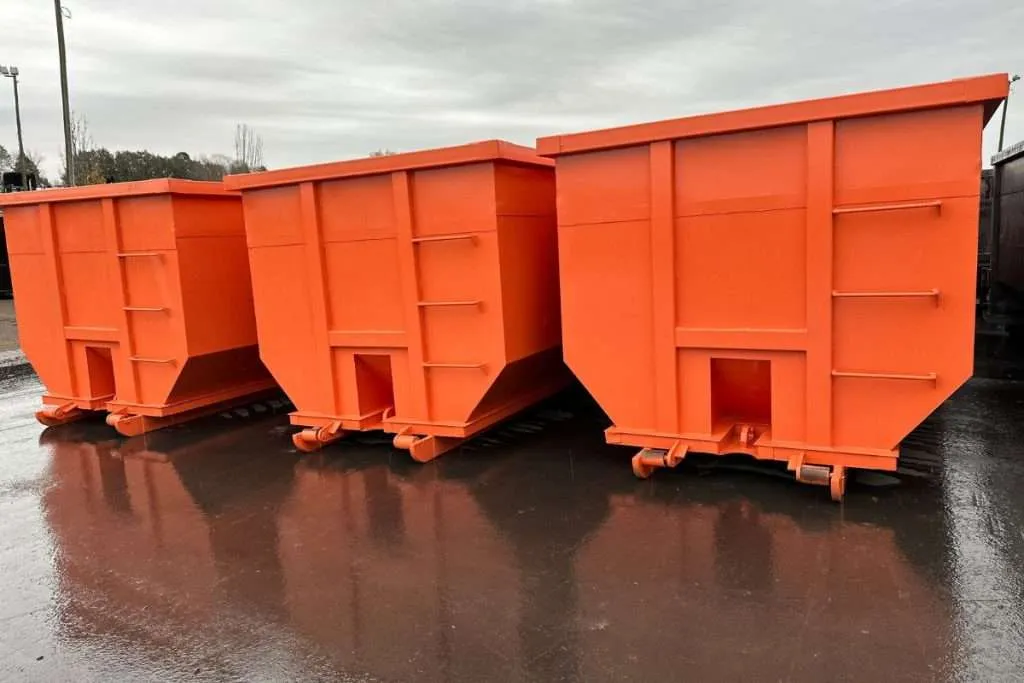
Design Overview
Tub style containers feature sloped, tapered sidewalls and a radius-bottom interior. This geometry improves unloading efficiency and allows containers to nest for transport.
Core Characteristics
- Tapered, curved sidewalls
- Rounded or radius-bottom floor
- Rear swing gate
- Lighter overall structure compared to box style
- Nestable for shipping efficiency
Where Tub Style Containers Excel
- General waste
- Roofing tear-offs
- Yard debris and green waste
- Junk hauling and residential cleanouts
- Mixed, loose material
Operational Advantages
- Improved dump-out: Sloped walls help material slide cleanly during unloading
- Shipping efficiency: Nesting reduces freight cost per unit
- Payload flexibility: Lighter tare weight supports legal payload limits on smaller trucks
- Faster turnaround: Reduced hang-up during dumping
Tub style containers are commonly used where unloading speed and logistics efficiency matter more than extreme impact resistance.
Box Style vs. Tub Style: Operational Comparison
| Consideration | Box Style | Tub Style |
| Sidewall Geometry | Straight, reinforced | Tapered, sloped |
| Impact Resistance | High | Moderate |
| Dumping Efficiency | Moderate | High |
| Nesting for Shipping | No | Yes |
| Typical Duty Cycle | Heavy-duty | Light to medium-duty |
| Material Density | Dense and abrasive | Loose or mixed |
| Initial Cost | Higher | Lower |
| Long-Term Durability | Maximum | Application-dependent |
Choosing the Right Container for Your Operation
1. Material Type
- Concrete, scrap, demolition: Box style
- Roofing, green waste, junk hauling: Tub style
- Mixed routes: Maintain both styles
2. Loading Method
- Machine loading with skid steers or loaders favors box style
- Manual or rear-door loading favors tub style
3. Truck Compatibility
Containers must match:
- Cable or hook lift systems
- Rail spacing and hook height
- DOT overhang allowances
Compatibility should always be confirmed before production—not corrected afterward.
4. Operating Environment
- Industrial and municipal settings favor heavier builds
- Residential and route-based hauling often favors lighter, nestable containers
Customization Considerations
Both container styles can be configured to support specific operational needs, including:
- Reinforced floors and sidewalls
- Drainage or watertight configurations
- Combo hook-and-cable compatibility
- Tarp systems and gantries
- Custom paint and fleet branding
Customization should be driven by material stream and route economics, not aesthetics.
Durability and Maintenance Reality
Design influences maintenance patterns:
- Box style containers resist deformation but may retain wet material in corners
- Tub style containers clean out faster due to sloped geometry
Regardless of style, long service life depends on:
- Fully welded seams
- Proper steel thickness
- Routine inspection of rails, rollers, hinges, and doors
Well-built containers remain productive assets for years when matched to the right application.
Final Takeaway
Choose box style containers when durability, impact resistance, and structural longevity are critical.
Choose tub style containers when unloading efficiency, shipping logistics, and lighter-duty hauling drive ROI.
Most professional fleets deploy both, assigning each where it performs best.
Ready to Equip Your Fleet?
At SSMC, we manufacture custom roll-off containers built to handle real job site conditions across the construction, waste, and industrial sectors. Whether you need box style, tub style, or something in between, we’ll help you choose the perfect fit.
📞 Contact us today for a quote or to learn more about container specs, pricing, and delivery timelines.
Frequently Asked Questions
1. Which container style lasts longer in heavy-use environments?
Box style containers typically last longer in high-impact applications such as concrete, scrap, and demolition. Their straight sidewalls and reinforcement columns resist deformation and fatigue better under repeated abuse. Tub style containers perform well in lighter-duty cycles but are not intended for sustained high-impact loads.
2. Do tub style containers actually unload faster?
Yes. The tapered sidewalls and radius-bottom design of tub style containers allow loose and wet materials to slide out more easily during dumping. This reduces hang-ups and cleanup time, especially for roofing, green waste, and general trash routes.
3. Why do some fleets run both box and tub style containers?
Mixed fleets allow operators to match container geometry to the material stream. Box styles are assigned to dense, abrasive loads, while tub styles handle lighter or loose material more efficiently. This approach maximizes container lifespan and overall fleet productivity.
4. Are box style containers heavier than tub style containers?
In most cases, yes. Box style containers use more steel and external reinforcement, resulting in higher tare weight. That added weight increases durability but may reduce legal payload on smaller trucks. Tub style containers are often chosen when payload limits are a concern.
5. Can both styles be built for hook lift or cable hoist systems?
Yes. Both box style and tub style containers can be built for standard cable systems, hook lift systems, or combo configurations. Accurate rail spacing, hook height, and round bar dimensions must be confirmed before production to ensure proper fit.
6. How should I decide which style to standardize across my fleet?
Standardization should be based on the materials you haul most often, your truck configurations, and your duty cycle. Fleets focused on demolition or scrap typically standardize on box style containers. Fleets running general waste or residential routes often standardize on tub style—or maintain both to cover multiple use cases.